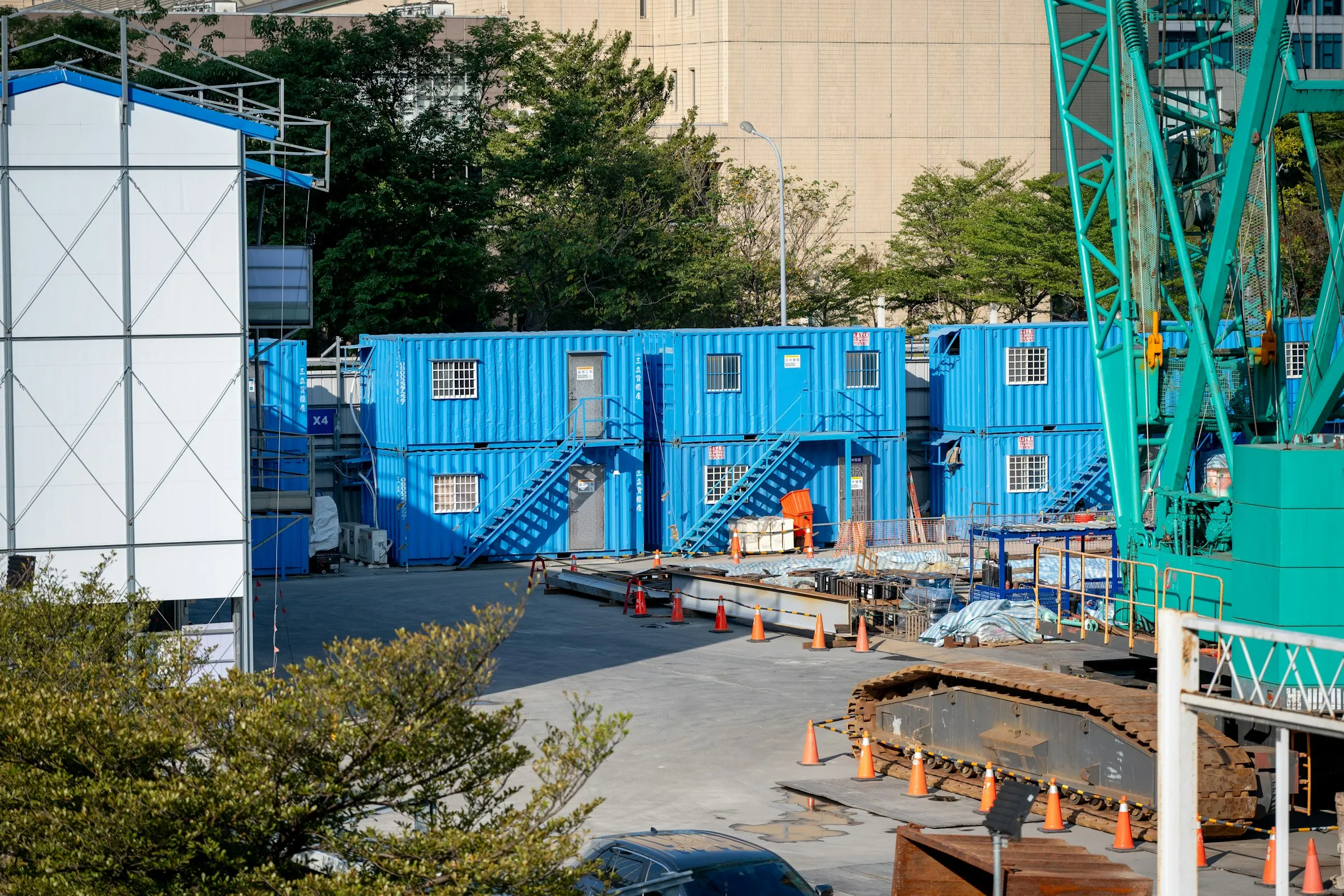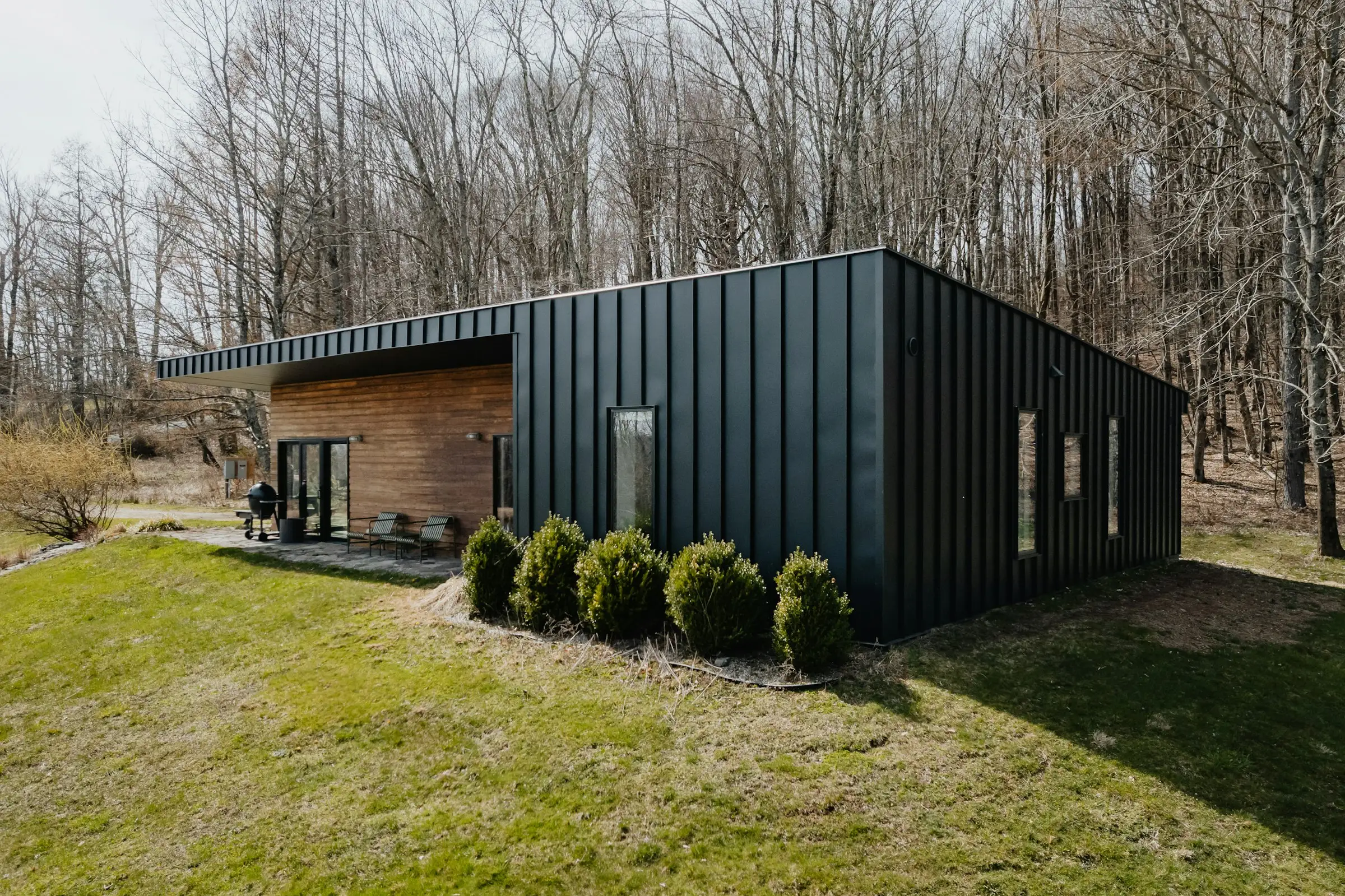
PU panels insulate best per millimetre, so they suit very hot or very cold climates. Rock wool is non-combustible and is usually chosen where fire codes or clients require it, for example in workers' camps. EPS is the lightest and lowest-cost core, best for mild climates and temporary use. Thickness matters as much as material: a 75 mm PU panel insulates roughly as well as 120 mm of EPS or rock wool.
The panels are the skin of a container house. They decide how comfortable the building is in a desert summer or a northern winter, how much power the air-conditioning uses, and whether the building passes the fire code. Most container houses use sandwich panels: two thin steel sheets bonded to an insulating core. The core is usually EPS, rock wool or PU.
The three common panel cores
- EPS (expanded polystyrene) — a lightweight foam made of small beads. It is the lowest-cost core and resists moisture well, but it is combustible.
- Rock wool (mineral wool) — fibres spun from molten stone. It is non-combustible and absorbs sound well, but it is the heaviest core and must be kept dry.
- PU (polyurethane, including PIR) — a rigid foam with the best insulation value per millimetre. It costs the most of the three. PIR, a variant of PU, generally performs better in fire.
Glass wool is a fourth option, often used in flat-pack modules. Like rock wool it is a non-combustible mineral fibre, but it is lighter and less heat-resistant.
Side-by-side comparison
| EPS | Rock wool | PU / PIR | |
|---|---|---|---|
| Thermal conductivity (typical) | 0.033–0.040 W/m·K | 0.035–0.045 W/m·K | 0.022–0.028 W/m·K |
| Fire behaviour | Combustible; usually the lowest rating | Non-combustible core | Better than EPS, but still a foam |
| Weight | Lightest | Heaviest | Light |
| Moisture | Absorbs little water | Loses insulation value if wet | Absorbs little water |
| Sound insulation | Fair | Best | Fair |
| Relative cost | Lowest | Medium | Highest |
| Typical use | Mild climates, temporary buildings | Camps, kitchens, fire-code projects | Very hot or cold climates, homes |
Typical published ranges for each material. Exact values depend on density and the manufacturer, so ask for the data sheet of the panel being quoted.
Lower thermal conductivity means better insulation. PU is about one and a half times as effective as EPS or rock wool at the same thickness.
Thickness matters as much as material
The table below shows approximate U-values (heat loss through the wall, lower is better) for common panel thicknesses. They assume conductivities of 0.038 for EPS, 0.040 for rock wool and 0.024 W/m·K for PU, and they ignore joints and the steel frame, so real buildings perform somewhat worse.
| Panel thickness | EPS | Rock wool | PU |
|---|---|---|---|
| 50 mm | ≈0.67 | ≈0.70 | ≈0.44 |
| 75 mm | ≈0.47 | ≈0.49 | ≈0.30 |
| 100 mm | ≈0.36 | ≈0.37 | ≈0.23 |
U-values in W/m²K, centre of panel, for comparison only — not a substitute for an energy calculation.
Two practical conclusions follow. First, going from 50 mm to 75 mm improves any core by roughly 30%. Second, a 75 mm PU panel insulates roughly as well as 120 mm of EPS or rock wool, which is useful when wall thickness is fixed.
Hot climates: start with the roof
In the Gulf, North Africa, Australia’s interior or the tropics, most of the heat enters through the roof, because it faces the sun all day.
- Put the thickest panel on the roof, even if the walls are thinner.
- Choose a light-coloured or reflective roof finish.
- On desert sites, consider a separate shade roof with an air gap above the building. It is common on camps in very hot regions.
- Shade windows and face doors away from the afternoon sun where the layout allows.
- In humid tropics, seal panel joints carefully and ventilate. Moist air can condense on cold, air-conditioned surfaces, and rock wool loses insulation value if it gets wet.
Cold climates: stop the gaps
In cold regions the weak points are usually the floor, the windows and the joints, not the wall panels.
- Use 75–100 mm wall and roof panels, or PU where winters are harsh.
- Ask whether the floor is insulated and with what. A well-insulated wall over a cold floor still feels cold.
- Specify double-glazed windows. They are standard on our expandable houses.
- Seal joints and steel connections, where heat escapes and condensation forms.
- Check the snow load. Our folding house roof is rated for 0.5 kN/m² as standard, with a reinforced 1.0 kN/m² option.
Fire codes come first
Before you compare comfort or cost, find out what your local fire code and your client require. Rules differ by country, building use and number of storeys. In practice:
- Workers’ accommodation for oil, gas and mining clients often specifies non-combustible rock wool panels.
- Kitchens and canteens usually need non-combustible cores, even if the rest of the camp does not.
- Single-storey temporary buildings in mild climates are where EPS is most often accepted.
You can mix cores on one project — for example rock wool for dormitories and kitchens, and EPS for stores.
Panel options on our products
| Product | Insulation options |
|---|---|
| Folding container house | 50 or 75 mm EPS, rock wool or PU; 75 mm roof panel |
| Expandable container house | 75 mm EPS, rock wool or PU; double-glazed windows |
| Flat-pack container house | 50 or 75 mm EPS, rock wool or glass wool |
| Prefab K-house | 50 or 75 mm EPS or rock wool |
| Space capsule house | PU foam insulation with low-E glazing |
What to ask for in a quotation
A quotation that just says “sandwich panel” cannot be compared. Ask each supplier for the core material, its density, the thickness of the wall, roof and floor panels, the steel sheet thickness and a fire test report for the panel. Our guide on reading a container house quotation explains how to compare these line by line.
Tell us your location and how the building will be used — we will recommend a panel specification for your climate and fire code, and quote within 24 hours.
Frequently asked questions
Which container house insulation is best for a hot climate?
PU panels give the most insulation per millimetre, and the roof matters most because it takes the strongest sun. Where the fire code requires a non-combustible core, use thicker rock wool instead. A light-coloured roof and a separate shade roof help as much as the panel choice.
Is EPS insulation safe in a container house?
EPS is combustible, so it typically has the lowest fire rating of the three common cores. It is widely used for single-storey and temporary buildings where local rules allow it, but many fire codes and clients require rock wool for accommodation, kitchens and multi-storey blocks. Check your local requirements before choosing.
What panel thickness do I need for a cold climate?
As a starting point, 75 mm walls for cool climates and 100 mm or PU panels for harsh winters, together with an insulated floor, double-glazed windows and well-sealed joints. Your local energy code may set minimum U-values, which take priority.
Does the insulation type change freight cost?
Usually not. The number of units per container is set by the folded or packed dimensions, so the panel core rarely changes it. Rock wool panels are heavier, which matters for lifting and handling on site.